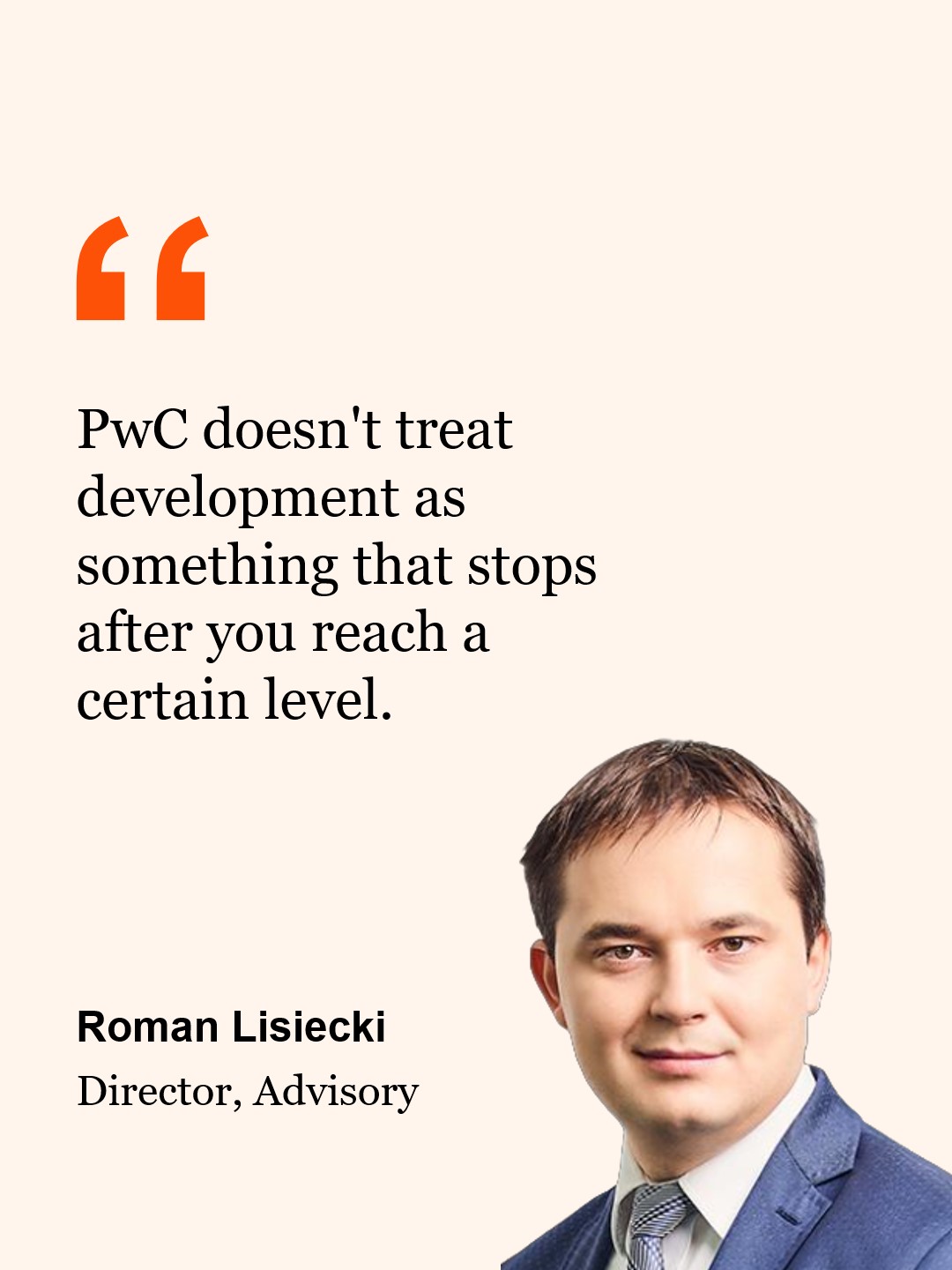
“Development doesn’t stop at senior level”
Ten years in, and still learning? Here's what that looks like.
When you're a director with 10+ years of experience, "development" sounds like something for graduates starting their first job — not for people who've already built teams and led complex projects. But after three years at PwC Poland, I learned something: development at this level doesn't look like a training program. It looks like the work itself — if you're in the right environment.
I joined PwC as a Director in Advisory three years ago. I wasn't looking for a complete change. I was looking for something specific: the ability to grow within a new team, in a challenging environment, without hitting a ceiling. When you're this far in your career, you're not trying to "get trained." You're trying to stay ahead — of technology shifts, client expectations, and your own capabilities. That needs different support.
So what does development actually look like? At my level, it's embedded in the work. Development happens while delivering projects — working with clients, solving problems you haven't seen before, being part of conversations that challenge what you know. It's also formal when needed: development programs, pan-European conferences, internal and external trainings. But the real growth comes from combining both — formal sessions that give you frameworks, and informal learning through stretch projects, mentorship, and cross-functional collaboration.
Most of your development comes through client engagements and project work. That's where real experience happens. Programs support it, but they don't replace it.
I wasn't surprised to still be learning at this stage. I expected it. New technologies and approaches emerge so fast — AI, regulatory changes, evolving client demands — there's always something to learn. If you stop, you fall behind. What I appreciate is that PwC doesn't treat development as something that stops after you reach a certain level. European conferences, networking, access to thought leadership — these aren't just perks. They're how you stay credible with clients and relevant in your field.
And here's what matters most: you have agency. For me it's about 50/50. My role has prescribed responsibilities, but I also have the flexibility to decide what I focus on and explore. That balance matters — because at this stage, you know what gaps you need to fill.
Do I see a path forward? Yes. New specializations, team development, business growth — work that contributes to the company and to my own growth at the same time. That's what makes development different at this level. It's not about climbing for a title. It's about building something — a new capability, a stronger team, a market position — and growing through that process.
If you're considering a move: there are many opportunities through programs and trainings, but that's not the main story. The main story is about what you'll build through client work, the teams you'll work with, and the problems you'll solve. If you think "I'm experienced enough — I don't need a company to develop me anymore," I'd say: stay open. Growth can happen in unexpected ways. It's worth trying.
Development at this level isn't about being taught. It's about staying ahead, deepening what you know, and leading with insight that comes from doing the work in an environment that supports it. If that's what you're looking for — the infrastructure is here. The question is whether you're still open to it.
When you're a director with 10+ years of experience, "development" sounds like something for graduates starting their first job — not for people who've already built teams and led complex projects. But after three years at PwC Poland, I learned something: development at this level doesn't look like a training program. It looks like the work itself — if you're in the right environment.
I joined PwC as a Director in Advisory three years ago. I wasn't looking for a complete change. I was looking for something specific: the ability to grow within a new team, in a challenging environment, without hitting a ceiling. When you're this far in your career, you're not trying to "get trained." You're trying to stay ahead — of technology shifts, client expectations, and your own capabilities. That needs different support.
So what does development actually look like? At my level, it's embedded in the work. Development happens while delivering projects — working with clients, solving problems you haven't seen before, being part of conversations that challenge what you know. It's also formal when needed: development programs, pan-European conferences, internal and external trainings. But the real growth comes from combining both — formal sessions that give you frameworks, and informal learning through stretch projects, mentorship, and cross-functional collaboration.
Most of your development comes through client engagements and project work. That's where real experience happens. Programs support it, but they don't replace it.
I wasn't surprised to still be learning at this stage. I expected it. New technologies and approaches emerge so fast — AI, regulatory changes, evolving client demands — there's always something to learn. If you stop, you fall behind. What I appreciate is that PwC doesn't treat development as something that stops after you reach a certain level. European conferences, networking, access to thought leadership — these aren't just perks. They're how you stay credible with clients and relevant in your field.
And here's what matters most: you have agency. For me it's about 50/50. My role has prescribed responsibilities, but I also have the flexibility to decide what I focus on and explore. That balance matters — because at this stage, you know what gaps you need to fill.
Do I see a path forward? Yes. New specializations, team development, business growth — work that contributes to the company and to my own growth at the same time. That's what makes development different at this level. It's not about climbing for a title. It's about building something — a new capability, a stronger team, a market position — and growing through that process.
If you're considering a move: there are many opportunities through programs and trainings, but that's not the main story. The main story is about what you'll build through client work, the teams you'll work with, and the problems you'll solve. If you think "I'm experienced enough — I don't need a company to develop me anymore," I'd say: stay open. Growth can happen in unexpected ways. It's worth trying.
Development at this level isn't about being taught. It's about staying ahead, deepening what you know, and leading with insight that comes from doing the work in an environment that supports it. If that's what you're looking for — the infrastructure is here. The question is whether you're still open to it.